What is Snapr?
Snapr is an AI-powered software engineer that integrates directly into your existing development workflow.
It listens to comments, reacts to events, and performs tasks like code generation, code review, issue refinement, or automated scanning. All from within your collaboration tools.
Instead of being a separate service or bot, Snapr behaves like a real teammate who:
- Understands context, intent, and codebase structure.
- Acts through simple commands written in your integration platform.
- Interacts with other developers on the project through your integration platform, making every interaction visible and transparent to the whole team.
Core Principles
Snapr is built around a few simple but powerful principles that keep it natural to use, safe to trust, and easy to manage.
Frictionless integration
Snapr lives where your developers already work, primarily inside your collaboration platform. You interact with it through comments, Issues, and Pull Requests, just as you would with any teammate.
Visibility and control
While day-to-day interaction happens in your integration platform, Snapr also provides an admin panel where you can monitor activity, manage scanners, configure the installation, and gain deeper insights into how Snapr contributes to your projects.
Safety first
Every action Snapr performs is transparent and traceable. It works through branches, Pull Requests, and standard workflows, ensuring your team remains fully in control of every change.
Data privacy and security
Snapr runs entirely within your own cluster. Your code, issues, and project data never leave your infrastructure, all processing happens in an isolated, controlled environment, ensuring complete confidentiality and compliance with your organization’s security policies.
Architecture
Snapr follows a simple and modular architecture designed for security, scalability, and transparency. It runs entirely inside your Kubernetes cluster, ensuring that your source code and data never leave your infrastructure.
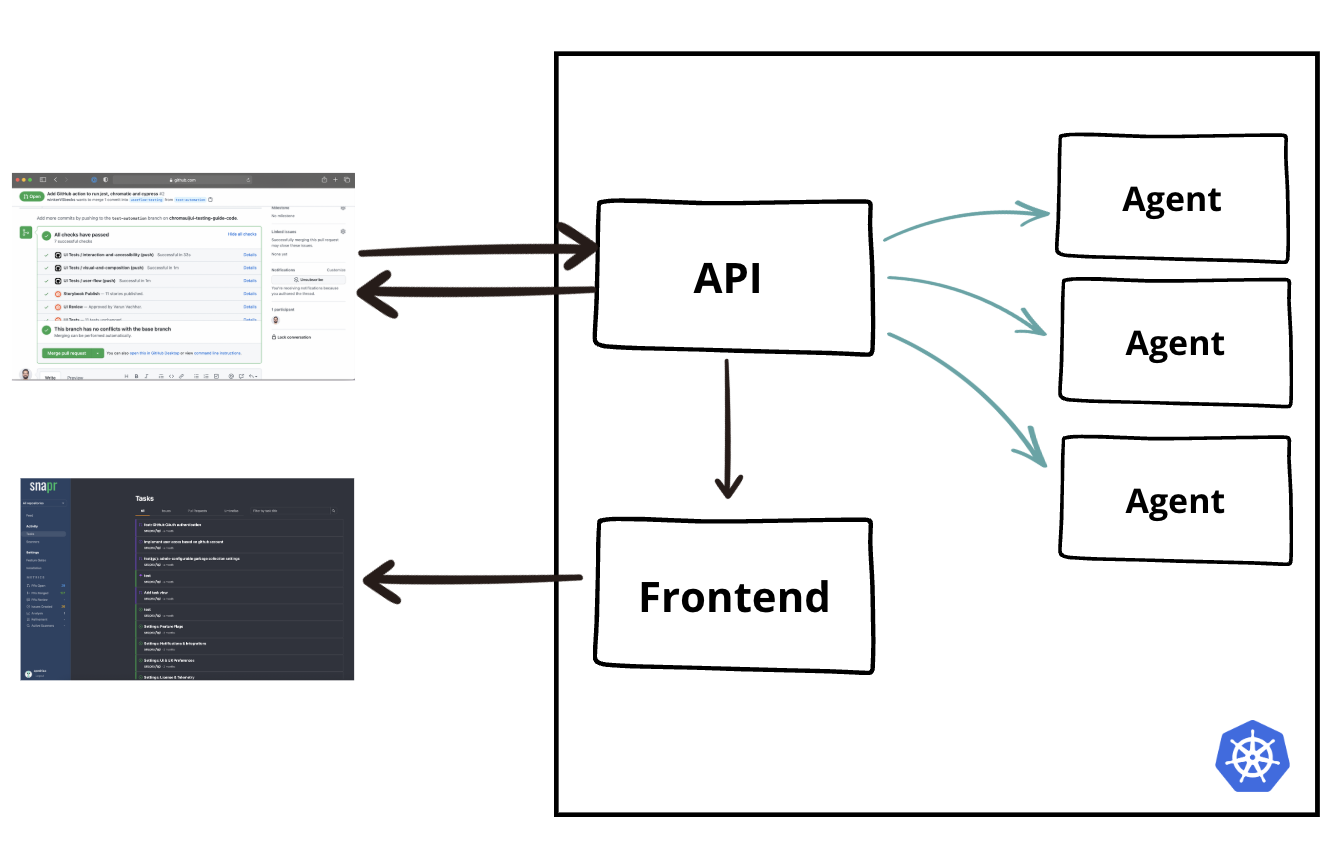
The system is composed of three main components:
- API – the core service that receives events from the integration platform webhook and orchestrates actions.
- Frontend – the web-based admin panel used for visibility, configuration, and monitoring.
- Jobs – short-lived, isolated Kubernetes pods that execute AI-powered tasks such as generating code, performing reviews, or running scanners.
Workflow
- An integration platform (e.g., GitHub, GitLab, or another supported service) sends a webhook to Snapr’s API when a trigger is detected, for example, a developer comments
/snapr developor/snapr review. - The API interprets the event and creates a Kubernetes Job to perform the corresponding action.
- Inside the Job, Snapr executes the AI agent, interacting with the project codebase and the configured AI provider.
- Once the task completes, the Job sends results (comments, PRs, issues) back to the integration platform and terminates.
Next Steps
- Install Snapr in your environment.
- Check Quick Start to see Snapr in action!